BY PAIGE MAHONEY
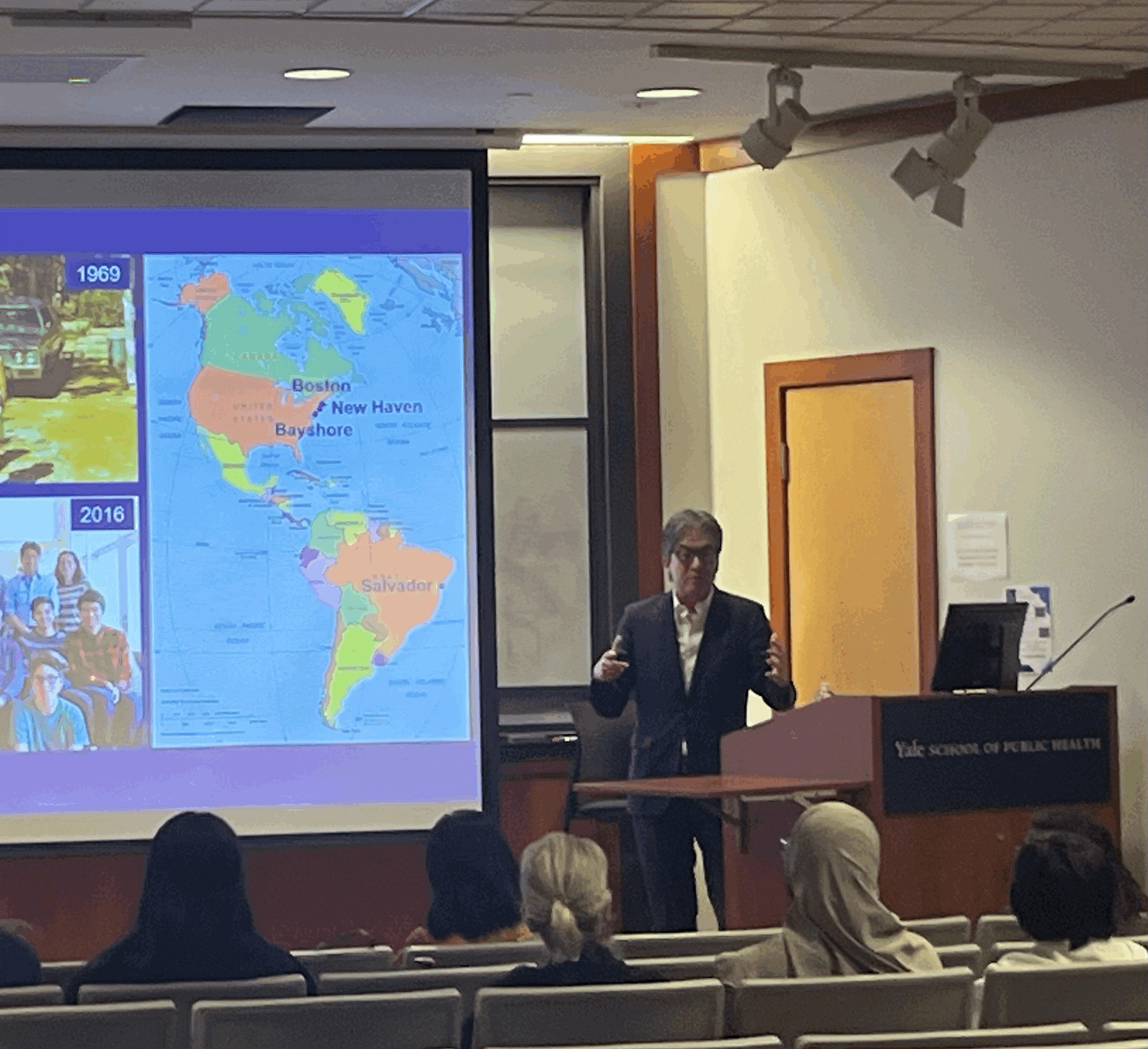
According to Dr. Albert Ko, MD, an infectious disease specialist and epidemiologist at the Yale School of Public Health (YSPH), “we cannot lose an opportunity to use science to correct injustice.” This principle has guided him since the beginning of his career, and it was a central throughline in his lecture on his journey through global health at the School of Public Health on Friday, February 20th.
Dr. Ko was February’s speaker for the Journey Lecture series at YSPH. Approximately once a month, the school’s Public Health Data Science and Data Equity Center invites a faculty member to speak about their career path: what surprised them, what went according to plan, and what advice they have for others working in the sphere of public health. For Dr. Ko, this last point was especially important—he has dedicated much of his career to training young scientists, both at Yale and in Brazil in programs designed to give local scientists the tools they need to support public health projects in their communities.
When you listen to Dr. Ko speak about his work, it is clear that he is driven by the people around him. It has been this way since the start of his career. Dr. Ko was originally drawn to science, and global health in particular, due to his family history. Both of his parents were born in Korea and moved to the United States when the Korean War broke out. Dr. Ko’s father developed tuberculosis shortly after his arrival and spent a year in a sanatorium in Massachusetts. He was one of the first people to receive streptomycin and isoniazid, a novel regimen that allowed him to recover from the disease. Dr. Ko’s mother was a graduate student at Boston University during a particularly progressive period in the school’s history. She passed along the fundamental idea of using science to serve others to Dr. Ko. That message, along with his father’s tuberculosis story, helped inspire his interest in infectious disease and global health.
As an undergraduate student at the Massachusetts Institute of Technology, Dr. Ko developed a passion for research, which continued throughout his medical school experience. After finishing his residency at Brigham and Women’s Hospital in Boston, he joined the Oswaldo Cruz Foundation in Salvador, Brazil as a visiting researcher. What was supposed to be a three year infectious disease fellowship quickly turned into a fifteen year project where he investigated the role that rapid, inequitable urbanization had on health outcomes in the city.
Dr. Ko credits his lifelong mentor Dr. Lee Riley, an early pioneer of decolonizing global health, with shaping his attitude towards his work in Salvador. To equip local students with global health research skills, Dr. Riley created courses in molecular epidemiology in Salvador in the early 2000s and later established the Global Health Emerging Scholars Program, a partnership between US universities, including Yale, and institutions in low-and-middle-income countries. Dr. Riley helped cultivate Dr. Ko’s deep respect for community engagement, which is perhaps most evident in his work on leptospirosis.
Upon his arrival in Salvador, Dr. Ko started work at a local infectious disease clinic. During a season of particularly heavy rainfall in the late 1990s, he saw an influx of patients with leptospirosis—a bacterial zoonotic disease that can cause severe liver and kidney damage. Most people contract leptospirosis by coming in contact with contaminated water or soil. Importantly, the disease seemed to attack the same, impoverished areas of the city each year and was associated with high rat burdens and rapid urbanization.
Identifying this pattern cemented Dr. Ko’s perspective on the importance of community-based public health: the only way to stop leptospirosis cases would be to improve the infrastructure failures causing people to become infected. The best way to achieve that aim would be through community engagement. Through a combination of Dr. Ko’s community driven research, advocacy that led to the closure of problematic sewer systems in Salvador, and the creation of urban health councils, the number of leptospirosis cases was significantly reduced.
One of Dr. Ko’s biggest takeaways from his work on leptospirosis in Salvador was the importance of “working where it matters—” in affected communities. Crucially, he says, public health research should benefit researchers and the communities they are working with. His work in Brazil certainly fits this criteria; he helped establish urban health programs that train local scientists, democratizing the field and empowering people to take charge of their own communities’ health.
In 2011, Dr. Ko moved back to the United States and joined the faculty at YSPH, where he has continued to mentor the next generation of global health researchers. His Journey Lecture was introduced by one of his current PhD students, Paloma Caracamo, who praised him for prioritizing “robust meaningful, impactful science” in every aspect of his career, both at Yale and beyond.
Throughout his long, impressive career in global health, Dr. Ko has been driven by a desire to use science for good and today, he continues to research infectious diseases in urban settings in Brazil. In addition to leptospirosis, Dr. Ko’s lab works on arboviruses such as dengue and Zika, as well as COVD-19. His strong relationships with scientists and students in Brazil makes researching such dynamic diseases possible. Just as important as Dr. Ko’s contributions to global health research, though, are his impacts on the next generation of scientists. Currently, he mentors a combined 25 PhD students and 48 postdoctoral fellows in the United States and Brazil and he noted that his greatest source of fulfillment has been “seeing [his] students do things better than [he] did.” It is clear he is passionate about creating systems that will continue to empower communities for generations to come. His dedication towards training students and sharing his expertise with them, whether through formal instruction or lecture presentations, has made that goal possible.