
BY EVAN BOWMAN
As surgical robots take over more of the operating room, surgeons feel their hands slipping further from the patient, and the trade-offs—costly machines, unequal access, and shifting skills—cut closer to the bone.
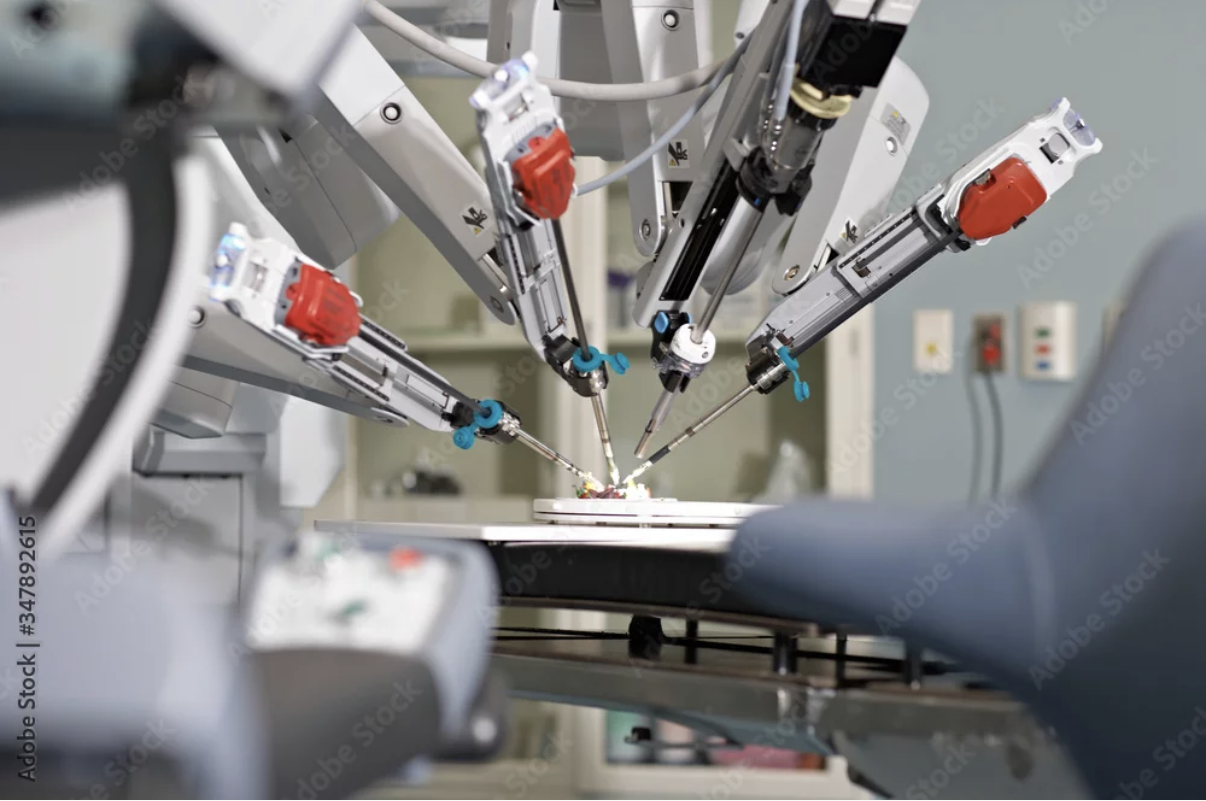
A patient lies asleep in the center of an operating room. Blue drapes cover their body, leaving only an opening on their stomach. From a towering white column in front of their feet, four jointed octopus-like arms reach over and into their belly. Video game noises overlay the rhythmic hospital beeps in the chilly room. A classic “beep boop” indicates when each metal wrist pivots to connect to ports that surgeons push into their stomach. Each robotic metal arm shines a blue LED light onto the patient from above. Surgeons, technicians, physician assistants, and nurses move sideways along the light-blue, tiled, old-school operating room walls to avoid bumping into the large white body of the robot that takes up most of the floor space around the patient and extends to the ceiling.
Across the room from the patient, Dr. Saber Ghiassi, a Yale gastrointestinal surgeon, and Dr. Peter Zhang, a seventh-year surgical resident and soon-to-be attending physician, sit docked into what looks like a virtual reality game. Their backs are to the patient, who lies across the room behind them. Their faces are obscured by goggles, and their hands are wrapped around thumbstick controllers. Zhang sits with his hands on the controllers, watching and mentally practicing for the day when he will be in the surgeon’s chair. The robotic arms move within the patient in tandem with Ghiassi’s hands. Ghiassi is removing the patient’s inflamed gallbladder from ten feet away.
Before the creation of surgical robots, surgeons had two options for their procedures: open or laparoscopic. Open surgeries involve making large incisions in patients so surgeons can use their hands to tie, repair, and remove items inside the body. Large incisions and more manipulation inside the body can lead to longer recoveries and more surgical risks. A less invasive form of surgery is laparoscopic surgery, where surgeons can reduce pain and complications by making tiny incisions and inserting long tools and cameras, which they can then manipulate with their hands. The newer, third option allows for surgeons to operate with robots using small incisions and inserted tools and cameras, but the surgeon isn’t holding the tools– a machine is. The surgeon controls the tools using a video game-type controller while watching the cameras on a screen.
Surgical robotics first became commonplace in the 1990s for heart surgeries. Operations that would previously be incredibly invasive– requiring an incision down the middle of the chest– could be done with small incisions and shorter recovery time. The most widely used surgical robots are called the da Vinci system, created by the company Intuitive Surgical. The first da Vinci system received FDA approval in the United States in 2000. Ghiassi encountered this early robotic system as a medical student after seeing some of the first robotic heart valve repairs. “I was just blown away by the technology,” he said.
The global adoption of robotic surgery has been rapid but deeply uneven. As of December 2024, there were more than 9,000 da Vinci systems installed worldwide, with the vast majority concentrated in the United States. As of mid-2025, the U.S. hosted 6,087 systems, compared with 2,006 in Europe, 1,854 in Asia, and 541 in the rest of the world combined. The African continent presents a stark illustration of this disparity. A 2024 scoping review found that only three African countries had published robotic surgery programs: Egypt, South Africa, and Tunisia.
Training in robotic surgery requires not only access to the machine itself but also institutional infrastructure: simulation labs, credentialing programs, and a steady volume of robotic cases. A residency program at a major academic medical center in the United States may now offer hundreds of robotic cases per year, while programs in resource-limited settings may offer none. The result is a bifurcated surgical workforce: one cohort mainly trained in advanced tools, and another trained on the techniques those tools were designed to replace.
The division between robotic training and traditional surgery may be partly attributable to the excessive costs associated with this advanced technology. In Ghiassi’s OR, a handwritten sign was taped to the wall, “Please do not throw these away! Code $550 each. Robotic long obturator.” The obturator is a disposable tube that creates a pathway for the robot’s instruments to enter the body. In a standard laparoscopic case, the equivalent part costs around $50. The robot requires a proprietary version that costs more than ten times as much. “Intuitive has had a monopoly for so long and has cornered the market so they can set the rates,” says Ghiassi. The obturator is only one example of dozens of disposables needed for each operation. These tools, along with software updates, training, and maintenance, are not included in the $2 million price tag.
The cost disparity for surgical robotics between wealthy and low-income countries is stark. In the United States, a robotic procedure carries an average hospitalization cost roughly $2,300 higher than its laparoscopic equivalent–a premium that has widened over time and is largely absorbed by insurance. Beyond the base system price of over $1 million, published research documents an additional $3,000 to $5,000 per-procedure cost associated with robotic surgery, driven largely by proprietary instruments and accessories. In countries without robust insurance systems, those costs fall entirely on patients. Only four sub-Saharan African countries have more than 20% of their population covered by health insurance, meaning the per-procedure premium alone can represent months of household income. In most of Africa and much of Latin America, the robots simply do not exist at all. The result is a global two-tiered system in which robotic surgery is becoming the standard of care in wealthy hospitals while remaining entirely inaccessible in settings that bear the greatest burden of surgical disease.
That gap is increasingly driving a new form of medical migration. Patients in countries where robotic surgery is unavailable or unaffordable are traveling abroad to access it, forming a pattern that maps onto the broader phenomenon of medical tourism. Robotic surgery’s appeal is specific: it promises less pain, faster recovery, and smaller scars, advantages that can matter enormously for a patient who must fly home soon after the procedure. Destinations like Thailand, Turkey, India, and South Korea have emerged as hubs for robotic surgical tourism, investing in high-end equipment to attract international patients. For the wealthy, this movement is a form of choice. For those who cannot travel, it is a reminder of what remains out of reach.
Dr. Andrew Eppstein, now a robotic surgeon at Indiana University, was a young doctor in 2012 when his hospital purchased the third-generation da Vinci SI. “I found very few great applications for the robot at that time,” he said. Six years later, however, in 2018, Eppstein had a case that changed his view. A patient came to him with a difficult hernia that another surgeon had tried to fix and had failed. Eppstein knew that if he repaired the hernia with his usual laparoscopic technique, it would fail again. The patient was a French horn player, and the pressure generated by blowing the horn throughout his body made the hernia repair even more challenging. “So I decided that this was the time to get back on the robot,” he said. Eppstein practiced with the robot so that when it was time to operate on his French horn patient, he could perform the procedure. He was able to fix the French horn player’s hernia. The French horn player was fortunate. He happened to live near a hospital with a robot and a surgeon willing to relearn it. Patients with equally complex cases at rural or under-resourced hospitals in and outside of the United States rarely have either.
“It’s really important for residents to learn laparoscopy. It’s a question of equity: you’re going to go places where they don’t have robotics. You should be able to offer these patients laparoscopy, not just open surgery,” says Ghiassi. Robotic systems are expensive, bulky, and difficult to move, so many smaller hospitals globally simply can’t host them. If residents like Zhang spend most of their time watching robotic cases, as is increasingly the norm in academic centers, they get less and less time to learn laparoscopy. Ghiassi noted that surgeons who learn laparoscopy first can transfer those skills to robotics, but the reverse is far harder. Laparoscopy is more technically demanding, but when it replaces open surgery, it can be much safer than open surgery. Because laparoscopy is relatively inexpensive, Ghiassi argues, it should remain available everywhere. A generation of surgeons who are robotics experts but uncertain with laparoscopic tools could leave patients in hospitals that cannot afford the robot, with no choice but riskier open surgery or traveling to find another surgeon.
Whether any of this will change remains an open question. Intuitive’s monopoly began to crack in 2016, when Intuitive Surgical’s patents on the basic concepts of the da Vinci design expired. Since then, they no longer owned the basic concepts for robotic controllers and robotic arms, and a race has begun among competitors to develop their own surgical robots. Medtronic’s robot, the Hugo, received FDA approval for urologic surgery in December 2025 and is explicitly positioned as a lower-cost alternative; unlike Intuitive, Medtronic also supports open and laparoscopic cases. Other competitors, including Johnson & Johnson, are in development. “By the nature of patented technology, they all have to make something from scratch,” says Dr. Justin Blasberg, a Yale thoracic surgeon and Director of Robotic Thoracic Surgery at the Yale School of Medicine. “But I think that competition will drive innovation and prices down.”
Whether prices will fall far enough to reach most of the world’s hospitals is another question. In its fifth generation, built on data recorded from every surgery ever performed on the robot, the da Vinci is highly refined. The company is valued at $203 billion. “A company that has five generations of robots and a tremendous monopoly in terms of just adoption, how does anyone catch up to that?” Blasberg said.
In operating rooms across the country, those blue LED lights continue to shine down on patients, and the video game beeps continue to sound. Surgeons dock into their consoles, their faces disappearing into goggles, their hands wrapping around controllers. And residents like Zhang continue to watch, preparing for a future where the technology they train on may not exist in the hospitals where they’ll work. The octopus arms extend and retract in a rhythm that has already become routine, even as the questions they raise remain unresolved.
The story of robotic surgery is, on its surface, a story about technology: iterating machines, expiring patents, and the relentless logic of innovation. But beneath it runs a quieter story about movement: about who can travel to reach a robot, about which surgeons are trained to use one, and about the patients left behind in hospitals where the machine will never arrive. Medicine has always migrated unevenly toward wealth, toward cities, toward the well-insured. The surgical robot is the latest expression of that pattern: patients cross borders to access it. Surgeons are trained on it in ways that may leave their future patients worse off. And the institutions that shape global health partnerships are only beginning to reckon with what it means to train a generation of doctors in skills that don’t transfer. What gets lost in the noise about the technology, as Ghiassi suggests, is not the technology itself, but the question of who it is for.
https://stock.adobe.com/images/robotic-surgical-equipment-in-hospital-surgery-room/347892615

——————————
Works Cited
- ACS. “Robotics Integration Ushers in New Era of Cardiac Surgery.” Accessed March 7, 2026. https://www.facs.org/for-medical-professionals/news-publications/news-and-articles/bulletin/2025/october2025-volume-110-issue-9/robotics-integration-ushers-in-new-era-of-cardiac-surgery/
- Miranda, David W., Omar Toubat, and Michael Ibrahim. “Robotic Cardiac Surgery: Past, Present and Future.” Nature Reviews Cardiology 23, no. 2 (2026): 81–82. https://doi.org/10.1038/s41569-025-01246-8
- MedTech Dive. Intuitive ISRG Q3 da Vinci 5 launch. https://www.medtechdive.com/news/Intuitive-ISRG-Q3-da-Vinci-5-launch/730298/
- Intuitive Surgical, Inc. Second Quarter 2025 Earnings Slides, July 22, 2025. Regional breakdown as of June 30, 2025: U.S. 6,087; Europe 2,006; Asia 1,854; rest of world 541. https://isrg.intuitive.com/node/22271/pdf
- Falola AF, Dada OS, Adeyeye A, et al. Analyzing the emergence of surgical robotics in Africa: a scoping review of pioneering procedures, platforms utilized, and outcome meta-analysis. J Minim Invasive Surg. 2024;27(3):142–155. https://doi.org/10.7602/jmis.2024.27.3.142
- Ng AP, Sanaiha Y, Bakhtiyar SS, et al. National analysis of cost disparities in robotic-assisted versus laparoscopic abdominal operations. Surgery. 2023;173(6):1340–1345. Average hospitalization cost: laparoscopic $16,000 vs. robotic $18,300 (difference ~$2,300). https://doi.org/10.1016/j.surg.2023.02.016
- Orienting global surgery initiatives toward advancing minimally invasive surgery in Africa. BMC Surgery. 2025. Per-procedure cost figure and insurance coverage statistic. https://doi.org/10.1186/s12893-025-02863-3
- Barasa E, Kazungu J, Nguhiu P, Ravishankar N. Examining the level and inequality in health insurance coverage in 36 sub-Saharan African countries. BMJ Global Health. 2021;6:e004712. https://doi.org/10.1136/bmjgh-2020-004712
- November 11, 2025 recorded phone interview with Dr. Andrew Eppstein.
- MDDI Online. Could Patent Expirations Be a Chink in Intuitive Surgical’s Armor? https://www.mddionline.com/business/could-patent-expirations-be-a-chink-in-intuitive-surgical-s-armor
- Medtronic. Medtronic announces FDA clearance of Hugo™ robotic-assisted surgery system for urologic surgical procedures. https://news.medtronic.com/2025-12-03-Medtronic-announces-FDA-clearance-of-Hugo-TM-robotic-assisted-surgery-system-for-urologic-surgical-procedures
- Iftikhar, M., Saqib, M., Zareen, M., & Mumtaz, H. (2024). Artificial intelligence: revolutionizing robotic surgery: review. Annals of medicine and surgery (2012), 86(9), 5401–5409. https://doi.org/10.1097/MS9.0000000000002426
- November 20, 2025 phone interview with Dr. Justin Blasberg.

