BY MYLA TOLIVER
In recent decades, there has been a dramatic increase in the prevalence of obesity in the U.S.: men’s rates rose from 11.7% in 1991 to 39.2% in 2021, and women’s from 12.2% to 41.3%1 2. This health crisis is expected to worsen, with a projected 50% of Americans expected to be obese by 2030, cementing the issue as a severe epidemic.1 The ethnic groups with the highest rates of obesity are those who have been historically systemically oppressed —Blacks/African Americans and Hispanics. Many of obesity’s social determinants—stress, lower socioeconomic status, and less flexible resources—disproportionately affect individuals in these groups.3
High obesity rates among recently immigrated Mexicans are particularly striking given Mexico’s long history of healthful, natural eating and farming practices. Traditional Mexican food culture emphasizes the routine consumption of staples such as corn, squash, beans, tomatoes, and other nutrient-dense crops. As a result, many recently immigrated Mexicans have historically exhibited longer lifespans than their non-Hispanic White and African American counterparts.4, 5 Sociologists and health scientists have termed this as the “Hispanic Paradox,” in which—despite often arriving in America with less financial capital, education, and overall resources—Hispanics still live longer than many other U.S. racial groups. However, Mexican Americans have increasingly become incorporated into the broader rise in U.S. obesity rates, raising uncertainty about whether these longevity trends can persist. Research indicates that the longer an immigrant resides in the United States, the greater their risk of obesity, a pattern often attributed to assimilation into the Standard American Diet (SAD)6. While the United States has an evident impact on eating habits, to fully understand the issue of obesity in Mexican immigrants, it is important to understand the obesogenic environments in Mexico and how these compare and connect with those of the U.S.
The signing of the North American Free Trade Agreement (NAFTA) in 1992 marked a watershed moment for the United States, Mexico, and Canada. By eliminating most tariffs on goods traded among the three nations, NAFTA created a more open commercial framework that encouraged cross-border trade and expanded job opportunities, albeit to varying degrees in each country.7 In Mexico, there were many concerns about whether the country could remain economically autonomous while preserving its cultural values and avoiding adopting some of the United States’ more harmful social and economic patterns. Despite these concerns, the promise of new jobs and a new world industrial economy proved deeply enticing.5
However, by allowing for the importation of subsidized food products from large U.S. industries, NAFTA undermined the small-scale farming system that much of Mexican society had originally relied on. Consequently, the distance between citizens and their traditional food production and consumption patterns widened significantly. As stated by Alyshia Gálvez in Eating NAFTA, “small-scale farmers find they can no longer afford to grow [corn], as it is becoming more common for it to be eaten in highly processed forms in chips, sweets, and sodas, rather than in tortillas, tamales, and atole.”5
With fewer Mexicans engaged in the physical labor of agriculture and by transitioning into the post-industrial, convenience-oriented ways of life the U.S. practiced, some of the traditional, healthy Mexican habits gradually came to be dismantled and replaced by American fast-food culture.5 As such, some critics argued that in terms of the consequences of NAFTA, “The only way Mexico became a ‘first world’ country was in terms of its diet.”8 To no shock, in following America’s diet, Mexico consequently began following its noncommunicable disease trends of obesity, hypertension, and diabetes. These consequences of separating from age-old food consumption practices in a leap towards globalization have not only been understood as a disease issue, but also as one of structural violence.
Structural violence, as defined by anthropologist Paul Farmer, is “a way of describing social arrangements that put individuals and populations in harm’s way.”9 Alyshia Gálvez firmly aligns this logic with NAFTA, arguing that both Mexican and American policymakers deliberately prioritized their nations’ corporate profit agendas over the health of individual citizens. While admitting that the rise of diet-related disease is multifaceted, she believes that this unhealthy food environment, with products engineered to foster addiction, is the main perpetrator of the obesity epidemic. Compounding this, she argues, is the growing ideology among those in power that health is an individual responsibility rather than the government’s, despite their role in the issue. As a result, health in Mexico has become stratified along economic and power hierarchies, facilitating both the “sickening of the population and the neutralization of demands they can make.”5
These obesity trends in Mexico have direct implications for immigration. The Mexican immigrants who come to the United States often arrive in better health than their counterparts who remain in Mexico, which is thought to be in part due to the physical exertion required to engage with the immigration process.10 However, research shows that the longer immigrants reside in the United States, the more their life expectancy tends to decline, even with the Hispanic Paradox. Several explanations help account for this shift. For one, if immigrants cannot readily access the ingredients for their ethnic food in their local community, they may turn to more American fast-food-style foods instead.11 Additionally, many immigrants tend to work jobs in America that are highly labor-intensive and underpaid, which limits the time available to devote to cooking healthy traditional foods if they do acquire the ingredients.12
There is also, of course, the unhealthy food environment in America itself, which markets to minority communities, supports the proliferation of processed food options in stores, and makes this food cheap and convenient.13 For Mexican restaurateurs, a popular profession in the immigrant community, U.S. customers’ expectations of ‘authentic’ Mexican food often include heavy doses of cheese, grease, sour cream, and other calorie-dense ingredients. This misconception leads cooks to meet these expectations at the expense of nutritional value, potentially pushing them further away from their traditional food habits.5
In addition, the undeniable differences in the social experiences of newly arrived individuals significantly influence how they navigate the American food system. There is evidence that xenophobic discrimination, which has been historically characteristic of American society, can also be a stressor that permeates into the physical well-being of minority communities and intensifies health issues.14 Especially for undocumented immigrants, workplace discrimination and exploitation are frequent and are compounded by threats of being reported to immigration authorities.15 Furthermore, for undocumented immigrants dealing with poor eating habits and weight management, they may not have the finances, government support, or the network to navigate these health issues, combined with potential fears of discovery of their status.3
Nevertheless, even with the climbing trends of obesity in Mexicans both in Mexico and in the U.S., the Hispanic paradox still holds true in some ways. As analyzed by clinical director and psychology professor John Ruiz, PhD, Mexican communities still have an overall higher lifespan than that of other races in the U.S.16 However, this gap in life expectancy is beginning to narrow, suggesting a potential decline associated with prolonged residence in the United States and a possible further escalation of the obesity crisis in Mexico. In addition, as Ruiz insists, longer life expectancy does not always mean a healthier physical being in itself.
While the barriers of an unhealthy food ecosystem and socioeconomic factors are strongholds in the persistence of obesity, there are active international intervention initiatives. As obesity rates are expected to continue climbing, efforts are underway at all levels to reverse them. At the institutional level, federal and national public health programs like Niños Sanos and Familia Sana (Healthy Children, Healthy Family) by the Centers for Disease Control assist families with nutrition and physical activity education, especially for those with Mexican farmworkers.17 At the community level, organizations such as the League of United Latin American Citizens (LULAC) launch initiatives in schools and neighborhoods to raise awareness about obesity and increase access to healthy foods.18 And certainly, on an individual level, people take advantage of these opportunities to better themselves and their families, and to find new ways to navigate a healthier lifestyle in America.
Altogether, the rising prevalence of obesity among Mexican immigrants and Mexican Americans reflects not a failure of culture or individual will, but the powerful influence of economic policy, labor demands, social inequality, and an aggressively marketed food environment. While historical shifts such as the North American Free Trade Agreement reshaped food systems in both Mexico and the United States, contemporary public health efforts demonstrate that change is possible when interventions are culturally grounded and community-driven. Preserving the strengths embedded in traditional Mexican foodways while dismantling structural barriers to healthy living will be essential not only for sustaining the longevity associated with the Hispanic paradox, but also for ensuring that longer lives are healthier ones.
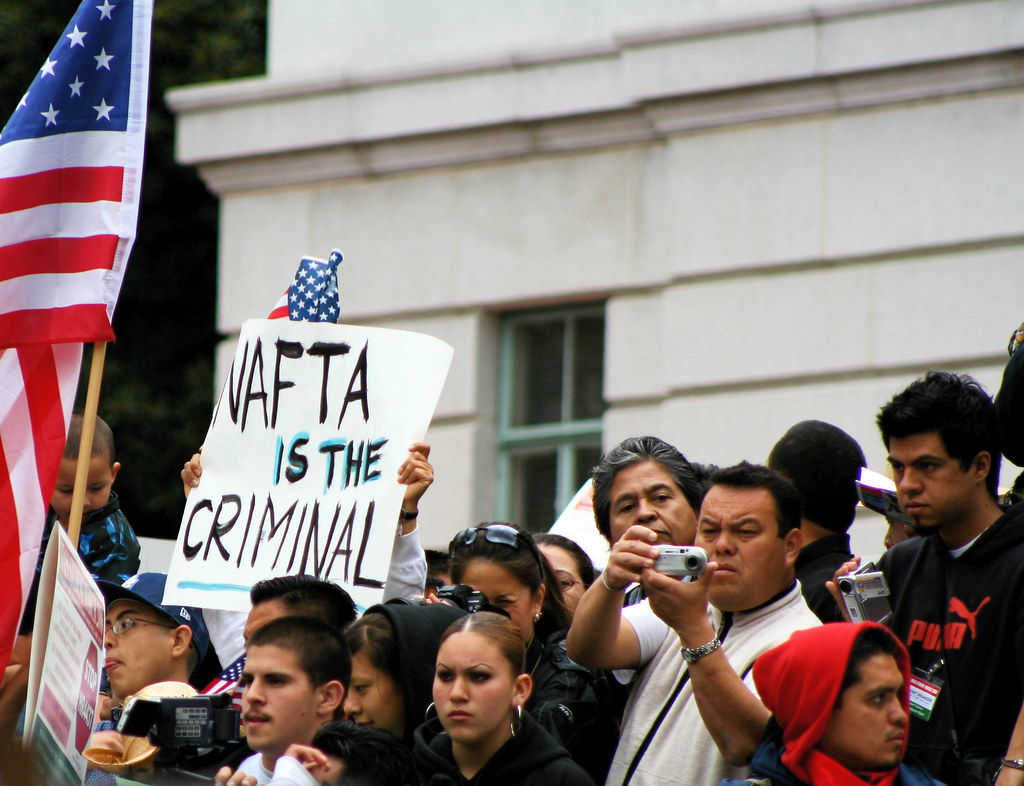
Protestors at a rally hold up a sign that reads “NAFTA is the Criminal.”
——————————
References
- Obesity and severe obesity prevalence in adults: United States, August 2021–August 2023. NCHS Data Brief. https://pubmed.ncbi.nlm.nih.gov/39808758/.
- The spread of the obesity epidemic in the United States, 1991–1998. NIH data. https://pubmed.ncbi.nlm.nih.gov/10546690/
- Fundamental cause theory. https://pubmed.ncbi.nlm.nih.gov/20943581/.
- Unraveling the Hispanic health paradox. https://www.aeaweb.org/articles?id=10.1257/jep.37.1.145.
- Eating NAFTA: Trade, Food Policies, and the Destruction of Mexico. http://www.jstor.org/stable/10.1525/j.ctv3znx6r.
- Dietary habits in the USA in the context of migration and acculturation. https://pmc.ncbi.nlm.nih.gov/articles/PMC11914326/.
- Mexico under NAFTA: a critical assessment. https://www.sciencedirect.com/science/article/pii/S1062976903000528?via%3Dihub.
- A nasty, Nafta-related surprise: Mexico’s soaring obesity. https://www.nytimes.com/2017/12/11/health/obesity-mexico-nafta.html.
- Structural violence and clinical medicine. https://pmc.ncbi.nlm.nih.gov/articles/PMC1621099/.
- The healthy migrant effect. https://pmc.ncbi.nlm.nih.gov/articles/PMC2156065/
- Foodmaps. https://www.tandfonline.com/toc/gfof20/15/3-4.
- Latinx immigrant workers’ challenges and collective responses in the rural US food system.https://oxfordre.com/foodstudies/display/10.1093/acrefore/9780197762530.001.0001/acrefore-9780197762530-e-59.
- Food Politics: How the Food Industry Influences Nutrition and Health. https://doi.org/10.1525/9780520955066-004
- Discrimination on immigrant and refugee physical and mental health. https://pmc.ncbi.nlm.nih.gov/articles/PMC6553658/
- Behind the Kitchen Door. https://www.jstor.org/stable/10.7591/j.ctt1xx52w
- Hispanic mortality paradox. https://pubmed.ncbi.nlm.nih.gov/23327278/.
- Mexican immigrant study protocol for combatting childhood obesity. https://pubmed.ncbi.nlm.nih.gov/24172250/.
- League of United Latin American Citizens. https://lulac.org/programs/health/obesity_nutrition/

