BY SIMRAN UTTURKAR
As the impact of industrialization on environmental pollution becomes a growing issue through the years, the disparities that exist between low income and affluent communities becomes more apparent. The people left most vulnerable to this crisis have had systematically unequal access to resources, political power and opportunities, and have been historically marginalized due to disinvestment. In cities such as New Haven, environmental injustice has created a perfect storm, as the public health of residents is threatened by disproportionate exposure to pollution, industrial waste, and extreme heat.
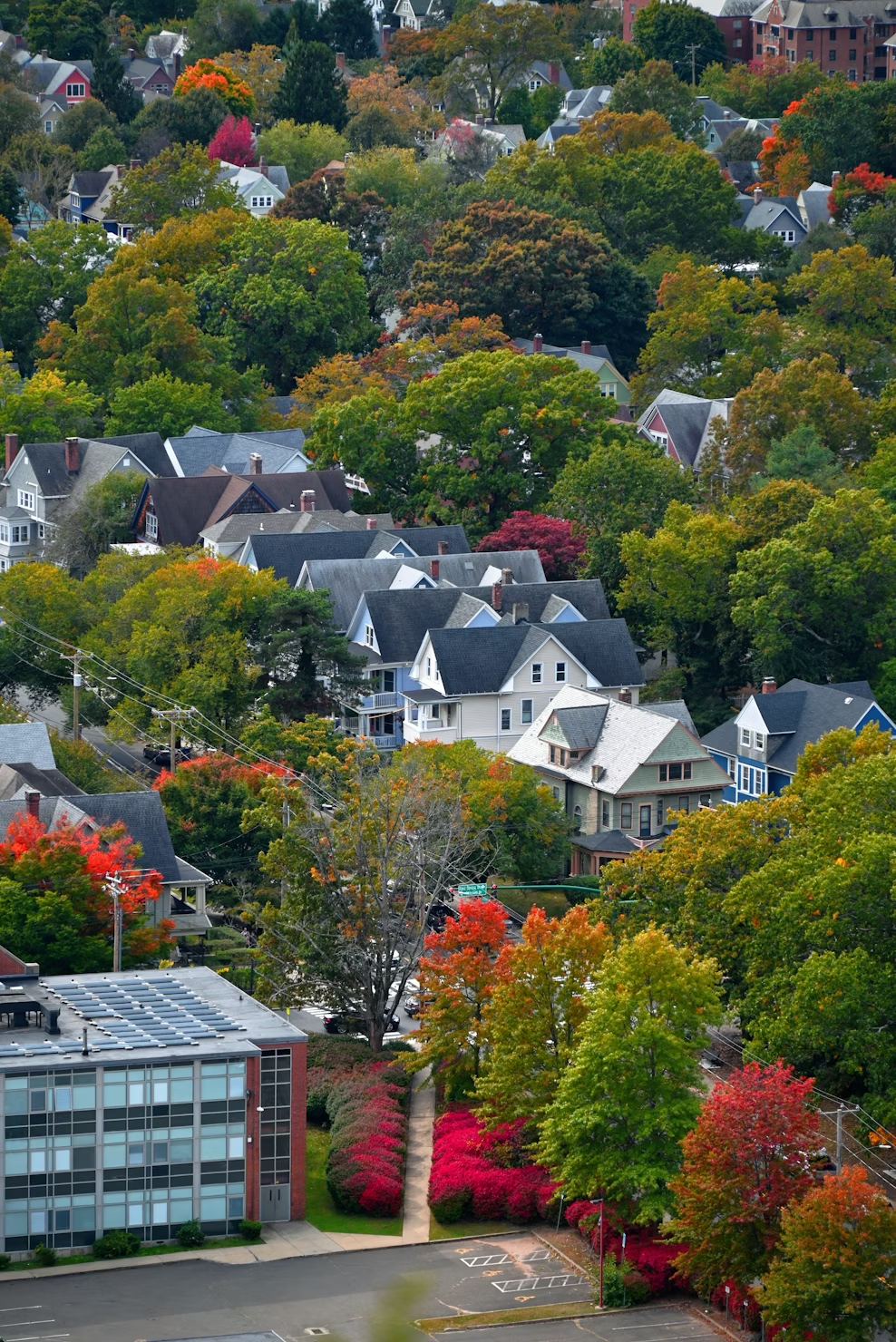
New Haven, Connecticut
Source: https://unsplash.com/photos/a-city-with-lots-of-houses-and-trees-JpyUCtwShJM
A History of Systemic Injustice
In this context, it is important to understand the definition of environmental justice and its impact on public health. Environmental justice is the idea that everyone, regardless of their race, income, or background, deserves to live in a healthy environment1. However, a history of redlining, the practice of denying investments and cancelling projects in areas deemed to be a “poor financial risk” based on race and income, has left low-income New Haven neighborhoods more vulnerable to environmental hazards. In the mid-1900s, New Haven received more money for urban renewable per person than any other U.S. city in order to create low-income housing products and improve the quality of life for the city’s poorer residents2. That said, in the 1930s, the city’s Home Owner’s Loan Corporation (HOLC) created maps that rated neighborhoods from A (the best, marked in green) to D (the worst, marked in red). These maps were part of the redlining process, which guided which areas of New Haven received more investment. Areas with many people of color and immigrants were deemed as risky, receiving less funding as a result. Today, while New Haven is one of the most racially diverse cities in Connecticut, neighborhoods graded C or D have not been able to enjoy the fruits of urban renewal and redevelopment projects that A or B graded neighborhoods have, such as green infrastructure, improved water management, and waste recycling.
As a result of redlining, these neighborhoods have a greater burden of air pollution from older oil heat systems, experience the urban heat island effect, and are near a higher density of waste sites. Outdated heating systems that rely on gas for heating and cooking instead of electricity release indoor pollutants. These include carbon monoxide, which interferes with blood’s ability to carry oxygen throughout body; nitrous oxides, which are respiratory irritants that causes airway inflammation, coughing, wheezing and increased asthma attacks; particulate matter, which are microscopic solids and liquids that can increase risk for premature death; and air toxins such as ammonia, formaldehyde, and polycyclic aromatic hydrocarbons, which can cause cancer, birth defects, and other serious harms.3 Since most people spend around 90% of their time indoors, and indoor pollutants can be up to five times higher than outdoor levels, this can pose a serious risk to respiratory, neurological, and cardiovascular health. In addition, the urban heat island effect further increases disparities in health risks. Because of factors such as limited tree coverage, heat trapping infrastructure such as concrete, and low proximity to water bodies, the temperature in urban areas can be higher than their surroundings.4 The proportion of the population that is low income, at an at-risk age, and belonging to a racial or ethnic minority was found to be higher than average in the warmest neighborhoods in New Haven, making them more susceptible to heat stroke. Compounding these health risks are these communities’ proximity to waste facilities, which has been associated with adverse health outcomes such as rates of childhood cancers like leukemia and brain cancer, congenital heart defects, oral clefts, low birth weights, and other developmental issues.5 In addition, residents in these areas face elevated risks of asthma hospitalizations, chronic respiratory diseases, diabetes, and stroke-related deaths. However, proximity alone doesn’t always equate to exposure on the individual level, and many studies examining health outcomes in low-income communities are limited by inaccurate data and inaccuracies in race and ethnicity reporting, which needs to be addressed to make sure environmental justice research is more applicable.

Environmental pollution
Case Study of The Annex
One of the areas in New Haven that has been exposed to the most environmental hazards is the Annex. Because it is a low-income neighborhood located near the industrial waterfront on the Quinnipiac river, it is home to several oil terminals and municipal solid waste facilities, which release air and groundwater pollutants.6 Most of this waste comes from wealthier communities that have the power to avoid hosting such facilities themselves and treat residential neighborhoods as landfills. This is in stark contrast to communities in New Haven such as East Shore, in which water bodies are seen as assets that should be preserved. Other low-income communities in New Haven face similar issues, hosting heavily polluting sites such as power plants, major interstate highways, train depots, oil pipelines, and a sewage treatment plant with sludge from all over Connecticut.7
Air pollution from these facilities is an extremely significant health risk in New Haven’s marginalized neighborhoods. Oil terminals as described in the Annex release volatile organic compounds (VOCs) and polycyclic aromatic hydrocarbons (PAHs)8, which can cause respiratory, gastrointestinal, and neurological symptoms such as airway irritation, nausea, and headaches.9 In general, poor air quality accounts for increased hospitalization rates of 65 per 10,000 people due to asthma, which is the highest for New Haven in the state of Connecticut.10 Polluted environments are linked to a plethora of other adverse effects including heart disease, diabetes, chronic obstructive pulmonary disease, cancer, and developmental issues such as stunted lung growth.7 In New Haven and beyond, environmental injustice is inseparable to the lived experiences of residents in low-income communities.
Looking Ahead
By understanding how historical disparities shape the exposure to environmental pollutants, better interventions can be designed to protect vulnerable populations and enhance overall well-being. Governmental organizations should take these findings into account when evaluating environmentally burdensome facilities and land use, regulatory/enforcement efforts for pollution, and overall actively promoting environmental health justice and protections. Local New Haven organizations are already leading efforts to tackle the effects of pollution and advocate for stronger environmental policies. For example, Save the Sound works to preserve the Long Island Sound by monitoring water quality and restoring ecosystems that have been destroyed by industrial activity.10 Additionally, the New Haven Environmental Justice Network focuses on community-based solutions, such as increasing green spaces, promoting renewable energy, and improving public health resources in the most affected areas.11 In fact, Yale’s own Center for Environmental Justice (YCEJ) has collaborated with Yale School of the Environment and Yale Law School to launch New Haven People and the Environment Research Library (PERL), which is a database that contains research about the intersection of the environment and New Haven communities.12 As environmental injustice continues to unfold, it is imperative that we take action by supporting local environmental organizations like those mentioned and advocate for more equitable laws on the government side. The time for environmental justice is now.
——————————
References
- American Public Health Association. Environmental Justice. https://www.apha.org/topics-and-issues/environmental-health/environmental-justice (2025).
- Digital Scholarship Lab. Mapping Inequality: Redlining New Deal America. https://dsl.richmond.edu/panorama/redlining/map/CT/NewHaven/context#loc=12/41.3031/-72.9227 (2025).
- American Lung Association. The Health Harms of Fuel-Burning Appliances. https://www.lung.org/getmedia/7c5254b2-2eb6-4278-a5dd-63ec845975bc/Factsheet-on-Residential-Combustion.pdf (2023).
- Howard, L. M. Heat Stress in Urban Environments: A Case Study of Heat Vulnerability in New Haven, CT. Library Map Prize https://elischolar.library.yale.edu/cgi/viewcontent.cgi?article=1058&context=library_map_prize (2021).
- Brender, J. D., Maantay, J. A. & Chakraborty, C. Residential Proximity to Environmental Hazards and Adverse Health Outcomes. Am. J. Public Health 101, S37–S52 (2011).
- Save the Sound. Don’t Trash the Annex—Hearing to Fight Waste Expansion on Dec. 16. https://www.savethesound.org/2020/11/12/dont-trash-the-annex/ (2020).
- Greater New Haven Green Fund. About the Greater New Haven Green Fund. http://www.gnhgreenfund.org/about.html (2025).
- Tecam Group. Main environmental risks in tank storage terminals and how to mitigate them.
 Yale Global Health Review