BY F. KHAN
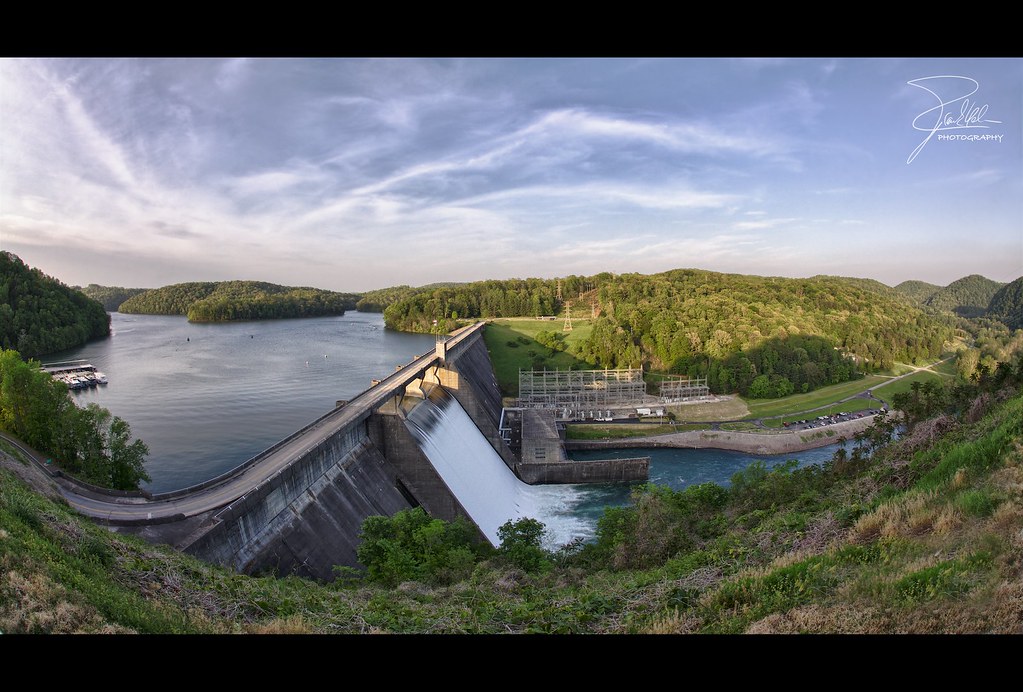
The boy is caught mid-jump, his toothy smile and extended limbs in kinetic motion, a striking contrast to the still waters corralled by the Norris Reservoir1 in Rocky Top, TN. Its construction began in 1933, making it the first dam to be built by the landmark Tennessee Valley Authority legislation, an agency that redrew the contours of the American Southeast.
As I turn the page in our family album, I see that same boy grinning widely again. Six-year-old me is seemingly delighted by the swirl of water lapping at my feet, oblivious to the turbulent 2010 monsoon season plaguing my family’s home province of Sindh, Pakistan. I am splashing in the shadows of the Sukkur Barrage, unaware that just 12 years later, the dam, constructed in 1932 by British colonialists, would threaten to unleash a tidal wave of disaster across an already-submerged Pakistan.3
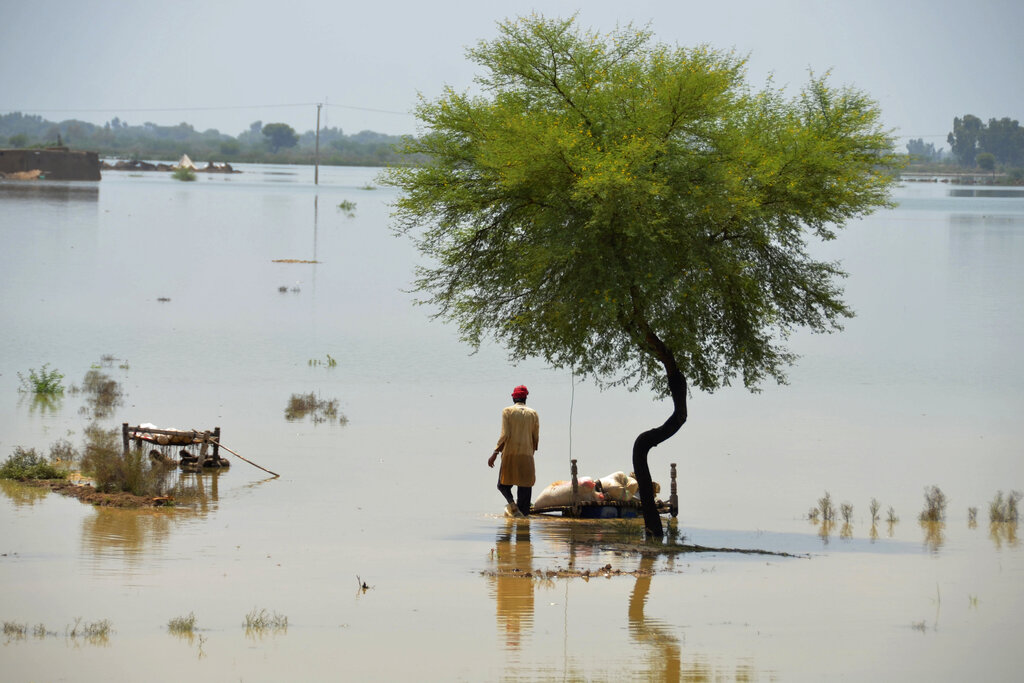
Melting glaciers and a monstrous monsoon season have choked Pakistan since June 2022, with widespread flooding killing over 1,700 people and displacing nearly 8 million others.5 But beyond the immediate threat of starvation, crop destruction, and people displacement lie even murkier waters, the spread of infectious diseases exponentially accelerated by flooding and climate change.6
Low-income countries have long tried sounding the alarm regarding how the consequences of global warming have been disproportionately felt by their nations, often despite minimally contributing to global greenhouse gas emission themselves. Notably, while Pakistan has only contributed to 0.4% of historic carbon emissions, the G20 nations have choked the atmosphere, responsible for 80% of such pollution.8 But even now, wealthy Global North countries continue to push back against these calls for financial accountability.9
Thus, much like the Earth’s atmosphere, the temperature is rising in the global arena, as Pakistan led a bloc of over 100 developing nations at the United Nations climate negotiations in Egypt, held in November, 2022.10 As Pakistan’s unprecedented flooding season continues to unfold, debate regarding the consequences of climate change again returned to the chopping block, with fierce contention regarding who should pay the cost.
“To the developing countries that are suffering these impacts because of the policies of industrialized countries over the past 150 years, this is a matter of climate justice.”
– Munir Akram, Pakistan’s Chief Climate Negotiator and permanent UN representative8
As Pakistan continues to pay the price for climate debts incurred primarily by the Global North, a closer look at the history of colonialism may help further elucidate these contentious global conversations happening in Egypt and elsewhere around the world.11
Prior to imposition of British colonial rule in modern-day Pakistan, indigenous populations used a more sustainable approach to irrigation and water management by implementing a communal schematic that, while servicing smaller swaths of land, prioritized agricultural sustainability over profit.12
However, the Brits, motivated by commercialization and financial gain, turned to the philosophy of the hydraulic mission, one pioneered by German American historian Karl Wittfogel to tout the use of Western science as a means to fix the problems of other nations.13 By recognizing that the control of water led to the control of subjects, the British Raj adopted this water management approach, which emphasized the construction of dams and levees to capture as much water as possible to channel back into agricultural economies.12
Despite attempting to mask their dam construction projects as acts of charitable public works, it is evident even from 1930s newspaper coverage of water management strategies that such British endeavors were primarily calculated attempts at exercising control over local populations to obtain revenue. For example, a 1933 clipping from The Times of India on the construction of the Lloyd Barrage (now the Sukkur Barrage) states, “This plain will certainly within the next ten years produce some of the finest crops in Sind [sic]. But nobody can be expected to sink capital here until the land has properly been protected from floods.”15
The Sukkur Barrage was considered the crown jewel of British Raj water management projects in the region, taming 6 million acres of land into fertile sites ripe for the harvesting of profit. To this day, this concept of taming the tempestuous Indus River through British colonialist hydraulic strategies endures, with recent Pakistani politicians like Imran Khan continuing to include the construction of new dams as part of his campaign promises.16
But even such political platforms seem to be a vestige of colonialism, representing subsequent inferiority complexes that can arise with escaping colonialist rule, as astutely pointed out by wildlife activist Zulfikar Ali Bhutto Jr., “From the military to industrialists, to landlords, everyone praises the irrigation network the British laid. The prevailing idea is not that the irrigation system itself was faulty, but that we as postcolonial subjects were not educated enough to maintain it, which couldn’t be further from the truth.”17
These British-inspired dams have made Pakistan even more vulnerable to climate change, causing the Indus River to recede as each drop is sucked back into cash crops, while also making the river more likely to swell and flood during monsoon season. Adding further salt (water) to the wound, the United Kingdom remains a top producer of carbon emissions globally, further exacerbating the dangerous climate conditions that now swamp their former colonies.18
UN secretary general Antonio Guterres stated that Pakistan is facing “a level of climate carnage beyond imagination.”19 Much like the waters engulfing a third of Pakistan, dengue, malaria, and cholera cases are on the rise.7 Climate change has been found to exacerbate the spread of over half of known human pathogenic diseases.20 For example, increased precipitation and flooding incurred by global climate changes have been linked to increased rates of malaria transmission. With Pakistani public health officials having anticipated over 2 million malaria cases by January 2023, it has become evident that even as the flood waters recede, the country reeled in a public health crisis of an unprecedented scale.21
UN delegates from around the world sat down in Egypt for the COP27 conference to discuss climate compensation for the future. But it is also imperative we analyze our histories with a fine-toothed comb, to recognize that the vestiges of colonialism are far-reaching and continue to actively mold our present.
So, as I put those photos back into our family album, it is a strange reality to see my present life and ancestral history collide, these two dams built just a few years apart. The roads leading to Norris Reservoir in my birthplace of Tennessee are often packed with greenhouse gas-emitting cars, filled with families ready to picnic at the water’s edge. But the fumes from their exhaust pipes are also fueling a catastrophe in my ancestral home of Pakistan, where families now huddle at the water’s edge, fighting for morsels to eat. Thus, we must continue to advocate for climate justice and explore the many ways our shared pasts are deeply intertwined with our hopes for a brighter (and drier) future.
F. Khan is a junior in Pauli Murray College.
——————————
References
- Norris. https://www.tva.com/energy/our-power-system/hydroelectric/norris.
- 5648292111_d41ccffa17_b.jpg (JPEG Image, 1023 × 692 pixels). https://live.staticflickr.com/5148/5648292111_d41ccffa17_b.jpg.
- Flood fate of thousands lies with colonial-era Pakistan barrage. France 24 https://www.france24.com/en/live-news/20220828-flood-fate-of-thousands-lies-with-colonial-era-pakistan-barrage (2022).
- Ashahid83. English: Old Is Gold.. Famous Sukkur Barrage. (2013).
- Devastating floods in Pakistan | UNICEF. https://www.unicef.org/emergencies/devastating-floods-pakistan-2022.
- Pakistan’s ‘climate carnage beyond imagination’, UN chief tells General Assembly | UN News. https://news.un.org/en/story/2022/10/1129337 (2022).
- pakistan-300822-ap.jpg (JPEG Image, 1024 × 683 pixels). https://media.freemalaysiatoday.com/wp-content/uploads/2022/08/pakistan-300822-ap.jpg.
- Kaplan, S. & George, S. At COP27, flood-battered Pakistan leads push to make polluting countries pay. The Washington Post (2022).
- John Kerry on the Current State of U.S. Climate Ambitions. (2022).
- Nations, U. Climate SDGs Conference 2022. United Nations https://www.un.org/en/climate-sdgs-conference-2022.
- Ziltener, P. & Künzler, D. Impacts of Colonialism – A Research Survey. J. World – Syst. Res. 19, 290–311 (2013).
- Siddiqui, Z. The Devastating Colonial Legacy of Dams in Pakistan. The Juggernaut https://www.thejuggernaut.compakistan-floods-dams-british-raj-colonialism.
- Frembgen, J. W. Asian Folk. Stud. 56, 433–436 (1997).
- Sukkur Barrage. Controversy Revived: Lor Lamington’s Fears. (1921, July 29). The Times of India.
- Sukkur Barrage at Work: IV- Some Astonishing Results. The Times of India (1933).
- Desk, N. PM vows to build 10 dams in as many years. The Express Tribune https://tribune.com.pk/story/2315221/pm-vows-to-build-10-dams-in-as-many-years (2021).
- Rivera Pichardo, E. J., Jost, J. T. & Benet-Martínez, V. Internalization of inferiority and colonial system justification: The case of Puerto Rico. J. Soc. Issues 78, 79–106 (2022).
- 2020 UK Greenhouse Gas Emissions, Final Figures. (2020).
- Wentworth, A. Pakistan’s ‘monster disaster’ shines a light on compensation. Climate Home News https://www.climatechangenews.com/2022/10/25/pakistans-monster-disaster-shines-a-light-on-compensation/ (2022).
- Mora, C. et al. Over half of known human pathogenic diseases can be aggravated by climate change. Nat. Clim. Change 12, 869–875 (2022).
- Flood-hit Pakistan may see 2.7 million malaria cases in 32 districts by January 2023: WHO. The Times of India (2022).
 Yale Global Health Review